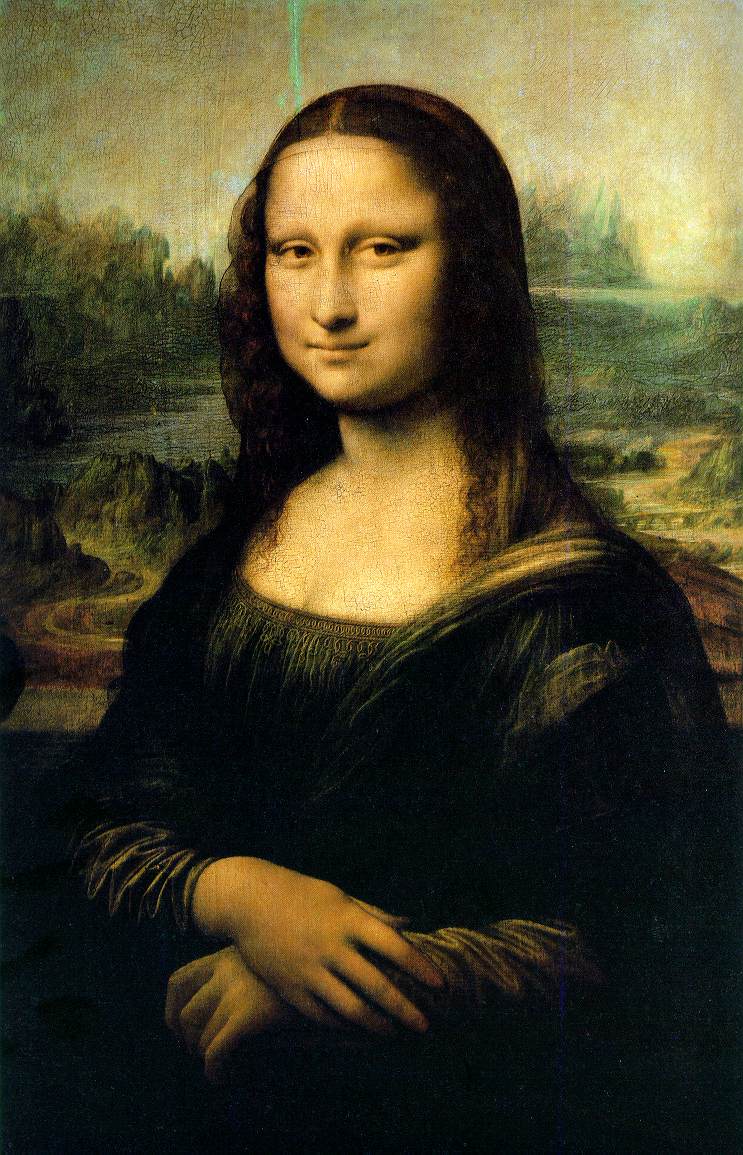
As any reader would be able to conclude, Langdon is intelligent. Not just intelligent, but incredibly smart on the scale that only one person could match his brains in his subject--the dead man (Mr. Sanuire). On page 127 when Langdon goes of on a tangent (of which is completely accurate) about the naming of the Mona Lisa. Mona Lisa was actually considered to be a "drag queen" version of Leonardo DaVinci. The Mona Lisa is neither man nor woman--based on the fact that Amon is the male god of fertility (which is "Mona" with the "a" placed infront of the "ona") and L'isa is the female goddess of fertility. Also, as Langon was explaining to his students, the left-hand side (which is considered the feminine side of things) is portrayed lower than the right-hand side (which is portrayed as the masculine side of things). By doing this, he makes the Mona Lisa look larger from his or her left side than DaVinci did on his or her right side. Given these two ironies, Leonardo DaVinci made a strong statement that the Mona Lisa is neither man nor woman, and possibly a representative (though a rather odd one) of himself. It turns out that Leonardo DaVinci was a homosexual...
 |
| Add caption |
Another aspect of the story that I find intriguing is Langdon not only travels off on tangents, but Dan Brown brings Langdon's classroom and lecture experiences into the present tense. Such is when he was explaining everything about the Mona Lisa.
Adding on to more of Langdon's character, I think that he is falling in love with Sophie at every turn her car makes. He loves her adventure, and he loves that a woman such as herself knows a ton of information regarding everything having to do with symbols. He is surprised, just like everyone else who encounters her. He loves her spunkiness and her attitude towards things, and he loves the fact that she cares. I don't think that Langdon is married, for that subject matter has not yet been brought up. Sophie is brave. Not just anyone would ask a taxi-cab driver to drive on and on and not be caught when they had purchased decoy train tickets. After discovering an address on the key, Sophie asks the cab driver where it is, and asking him to swiftly change his path of travel. This driver is one of their only hopes! (167)

After reading chapters 25-38 I feel that many of my personal ideas have been challenged in a good way. One of the most intriguing ideas was that the holy grail might really be a metaphor for something else rather than a physical cup that someone might drink from. I thought this was very interesting because I never actually thought that it might be a metaphor. I think that this book is extremely good for reasons like this, where the author challenges your thinking and makes the reader second guess what they have been told in their own lives.
ReplyDeleteIn connection with the key that Sophie has, I immediately knew what the key might look like because I knew what the fleurs-de-lis are. I saw them almost everywhere while I was in Italy and in Florence specifically. The Florentine fleur-de-lis always has the stamen in between the petals to distinguish it from others. The fleur-de-lis is a symbol for the city of Florence.
After being in Italy I can imagine exactly what the scenes might look like when the Opus Dei are meeting at Saint Peters Basilica or at a castle. I really like being able to connect with the scenery because it gives me a really vivid imagination of what the book looks like while I am reading it even if the author does not describe the scenery with any details.